
Copyright © 2026 Noor-ul-Emaan School, All rights reserved.
Home » The Day Our Karachi Campus Turned Green and White
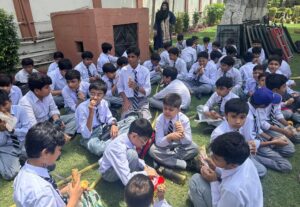
On most mornings the loudest sound in our corridors is the shuffle of feet toward the first class of the day. On the morning of the fourteenth, it was something else entirely a tide of green and white moving through the gates, small hands gripping paper flags, and a buzz that no ordinary school day could produce. Pakistan Independence Day had arrived at Noor-ul-Emaan School, and our Boys Campus in PECHS, Karachi was ready for every minute of it.
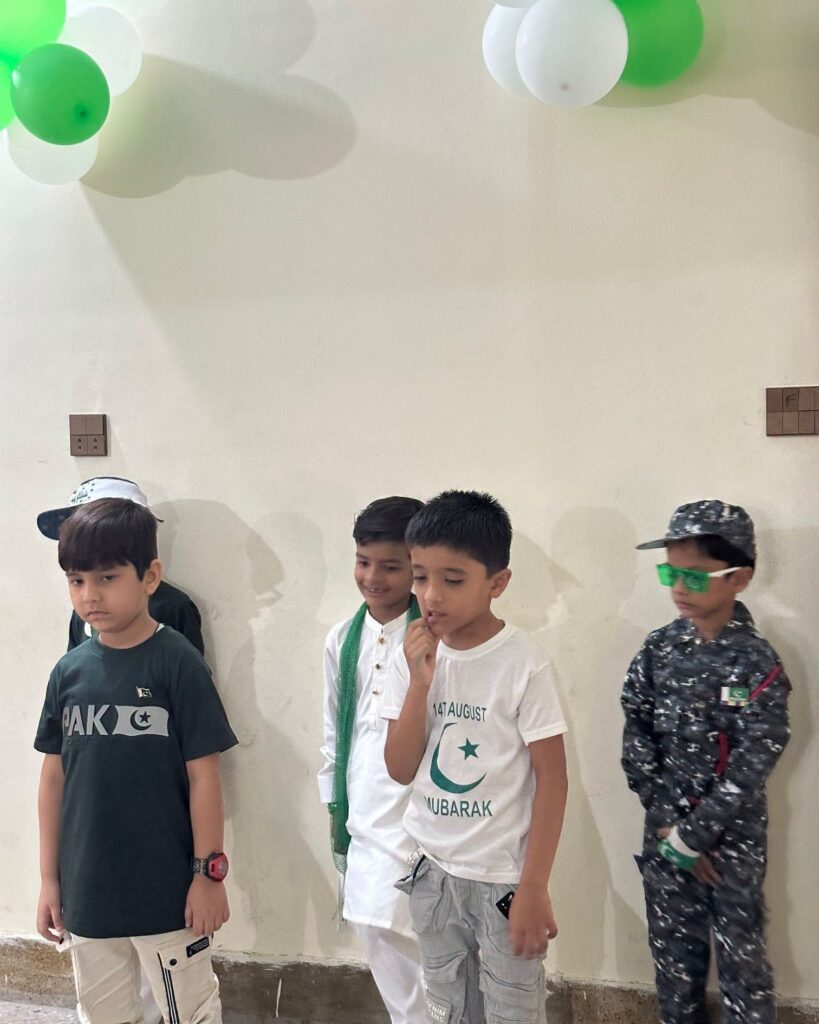
From Grade 1 to Grade 10, the boys came dressed for the occasion. Some wore crisp green kurtas, others pinned tiny flag badges to their collars, and a few had spent the evening before drawing crescents and stars they were far too proud to keep quiet about. This is the part of a school in Karachi that a syllabus can never fully capture: a whole community deciding, on the same morning, to feel something together.
Celebrated by Grade 1 to 10 together
Recitations, anthem and performances
Respect and responsibility, learned by doing
Boys Campus on Allama Iqbal Road
A 14 August celebration always begins before the first speech. It begins with the decorations that go up the night before, the streamers that refuse to hang straight, and the quiet nervousness of the boys who have a line to deliver in front of everyone. By assembly time our hall had turned into a small sea of green and white, and the energy was impossible to miss.
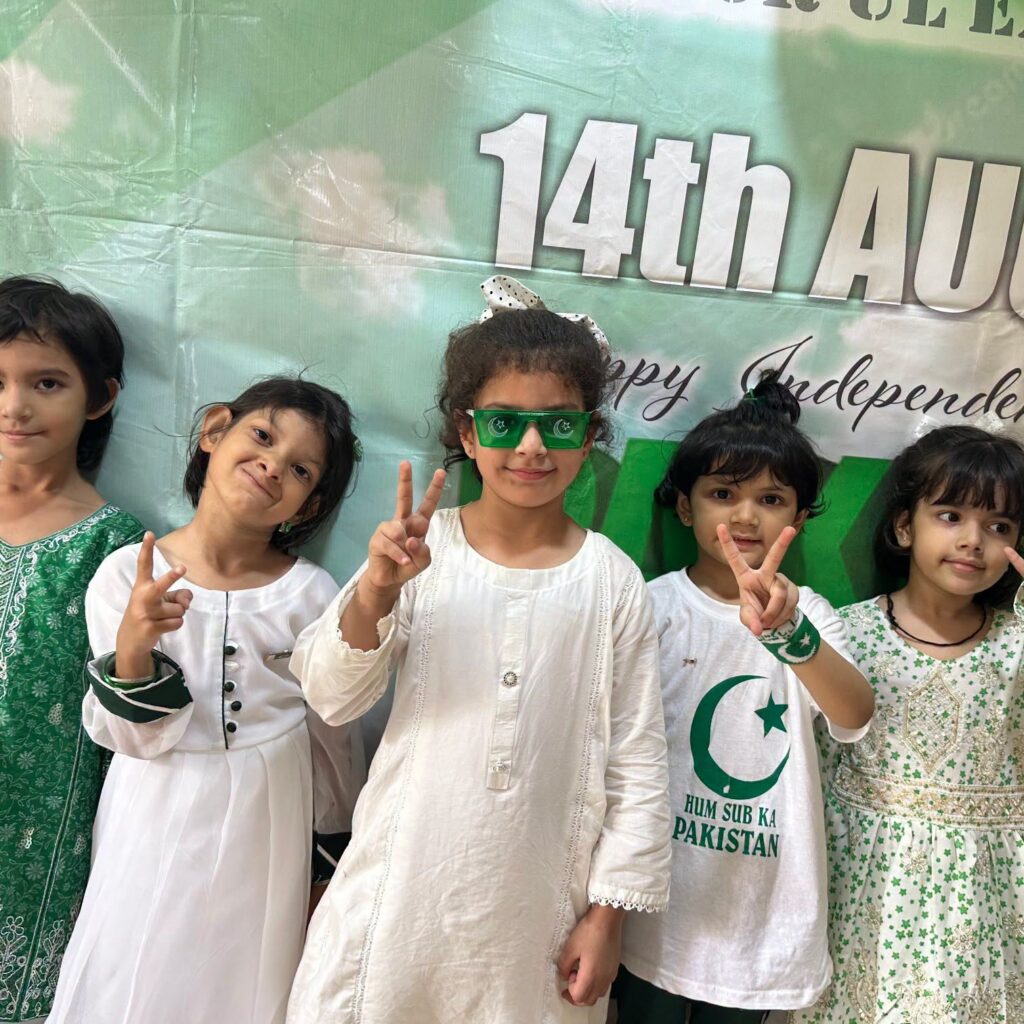
Classrooms and shared spaces carried the national colours from wall to wall. But the decorations were only the frame. What filled the picture was the students themselves, their curiosity about why the day matters, their excitement at taking part, and the way older boys naturally began helping the younger ones find their places. In a good school community, a celebration is never performed for the children; it is built by them.
Ask a Grade 1 student what independence means and you will rarely get a history lecture. You will get something more honest: “It’s our country’s birthday.” And in a way, that answer is exactly right. Before the dates and the treaties, 14 August is a feeling of belonging the sense that this land, this flag and this story are ours.
Our job as educators is to grow that feeling into understanding, one age-appropriate step at a time. For the youngest, that means flags, colours and songs. For our secondary students, it means harder, better questions: What did people give up so that this country could exist? What does it actually cost to keep a nation kind, fair and united? A meaningful Independence Day celebration at school holds space for both the six-year-old and the sixteen-year-old, without shrinking the day down for either of them.
The programme opened, as these mornings should, with the national anthem. There is a particular stillness in a hall full of children standing to attention, a rare, unforced quiet that even the most restless class settles into. For a moment, hundreds of individual mornings became one shared one.
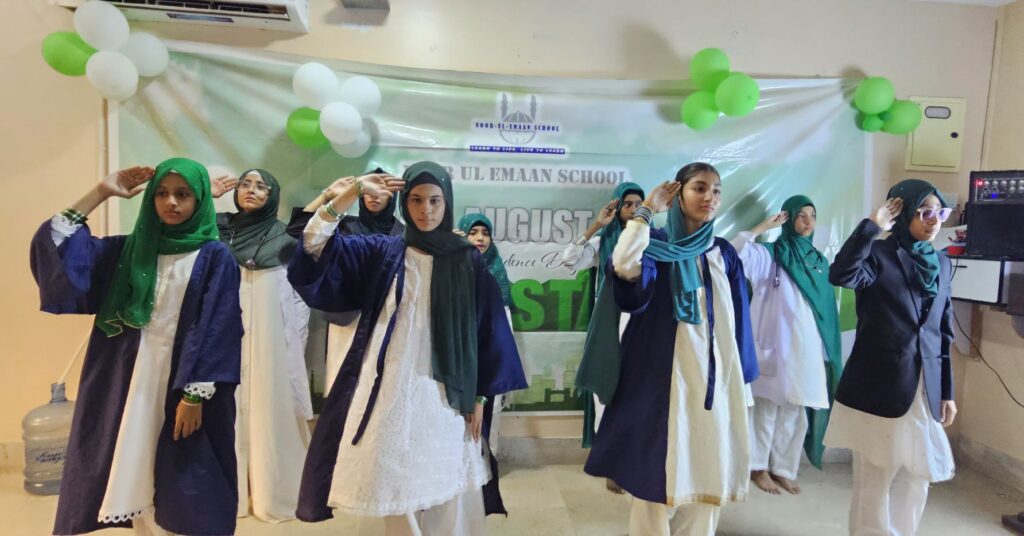
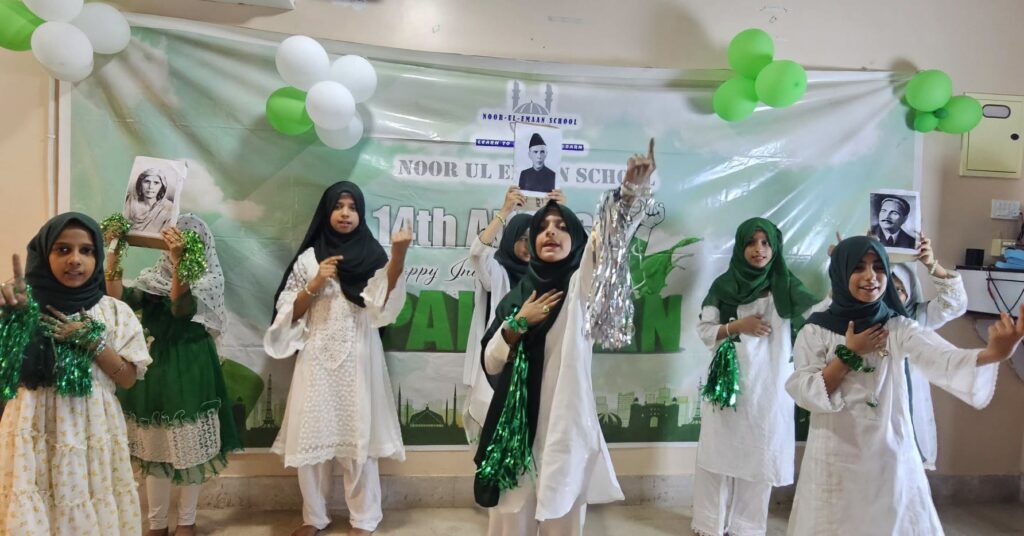
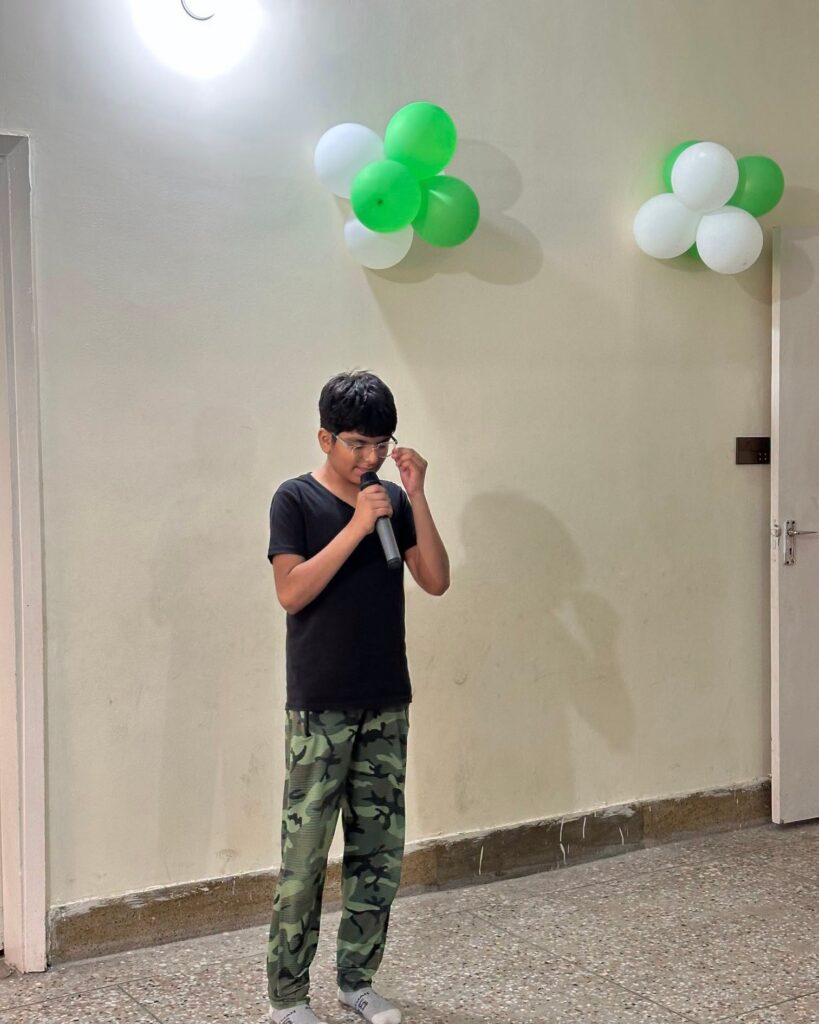
What followed was theirs. Boys recited, presented and performed pieces they had rehearsed all week. Some voices were confident and carrying; others wavered and then steadied and honestly, those were the moments worth watching most. A child who is nervous, steps up anyway, and finishes their line has learned something about themselves that no worksheet could teach.
It would be easy to treat 14 August as a break from “real” learning. We see it the opposite way. Days like this are where some of the most durable lessons happen the kind that shape character rather than just grades. Beneath the flags and the songs, the boys were quietly practising four things at once.
Speaking in front of the whole school is genuinely hard. Every student who tried a line, a poem, a role walked away a little braver than they arrived, and that courage travels straight back into the classroom.
A single assembly needs dozens of small hands: rehearsing, arranging, cueing, encouraging. The boys learned that a proud result on stage is really the sum of a lot of quiet cooperation off it.
National pride is at its best when it sits beside good manners. Standing respectfully for the anthem and listening while a classmate speaks are habits of adab that matter far beyond one morning.
Arriving prepared, following through on a role, caring for a shared space this is where citizenship actually begins. Not in grand gestures, but in small, dependable ones.
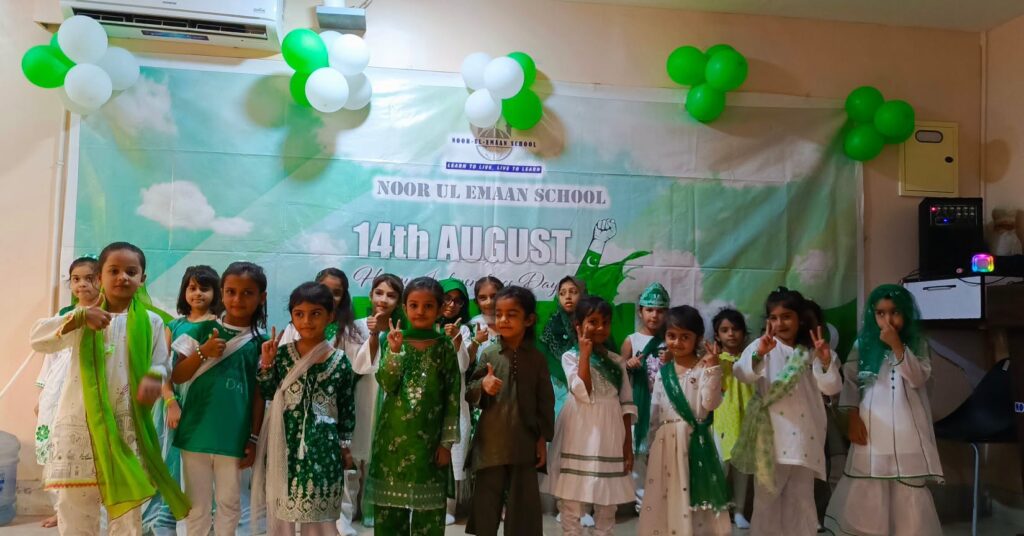
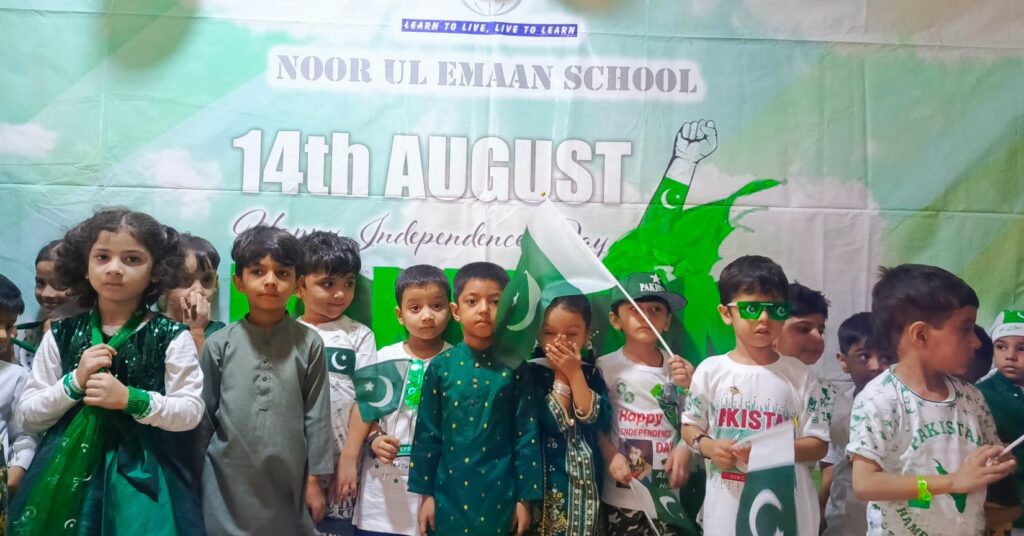
Children remember a celebration far better when they know what they are celebrating. So, woven through the morning, were the facts that give the day its weight. Pakistan became an independent country on 14 August 1947, as British rule over the subcontinent came to an end and a new homeland was born. Britannica’s account of Pakistan’s Independence Day lays out that turning point clearly for anyone who wants the fuller picture.
There is a detail our students always find surprising: much of that first chapter was written in their own city. Karachi served as Pakistan’s first capital, and it was here that the country’s founding assembly met and its first Governor-General, Quaid-e-Azam Muhammad Ali Jinnah, set the young nation on its path. For a child growing up in PECHS, history stops feeling like a distant textbook and starts feeling like a place they can point to. The oral histories collected by the Citizens Archive of Pakistan are real memories from people who lived through 1947 bring that year to life better than any summary can.
Even the colours the boys wore carry meaning, and it is a lovely thing to explain to a curious class.
The broad green field stands for the country’s Muslim majority, along with the crescent and star of hope and progress.
The white stripe is a deliberate, permanent promise: a place for Pakistan’s minorities, and a reminder that the nation was meant to make room for everyone within it. Explaining the white stripe to children is one of the simplest ways to teach that patriotism and tolerance belong together.
What students experienced | What it quietly taught them |
Standing for the national anthem | Focus, respect and a shared sense of belonging |
Reciting, presenting and performing | Public speaking, preparation and hard-won confidence. |
Wearing green and white, carrying flags | A first, joyful connection with national symbols |
A single day cannot build character on its own. What it can do is show, in miniature, the kind of school we are trying to be every day of the year. At Noor-ul-Emaan School, we believe education should prepare a child for examinations and for life which is why academics, Islamic values and character development are treated as one project, not three separate ones. You can read more about that approach on our About Us page.
For parents comparing an Islamic school in PECHS, Karachi, the everyday environment usually matters more than any single event the tone of the corridors, how children speak to one another, how a school marks its ordinary Tuesdays as well as its 14 Augusts. If that is the lens you are choosing through, our guide on choosing the right Islamic school in Karachi was written with exactly that decision in mind.
Our Boys Campus in PECHS, Karachi marked Pakistan Independence Day with a full assembly the national anthem, student recitations and performances, green-and-white decorations, patriotic dress and teacher-led messages on unity and responsibility. Students from Grade 1 to Grade 10 took part.
They connect classroom learning to real history and shared values, and they let children practise confidence, teamwork, respect and public speaking in a supportive setting. Just as importantly, they create positive memories of belonging to a school community.
Yes. Noor-ul-Emaan School offers education from Pre-Primary to Matriculation in PECHS Block 2, Karachi, combining the Karachi Board curriculum with Quran, Tafseer, Islamic values and character building. You can learn more on our About page.
For the current campus address, directions and visiting times, please see our Contact page, where you can also confirm timings before you come.
Visit our Admissions page to send an enquiry. Our team will get back to you to confirm available classes, required documents and the next steps for your child.