
Copyright © 2026 Noor-ul-Emaan School, All rights reserved.
Home » Activity Based Learning in Pre-Primary Classes
Walk past our Nursery classroom on any morning and you’ll rarely find children sitting silently with a book. You’ll find balloons in the air, paint on little hands and a lot of laughter. To a visitor, it can look like nothing more than fun. To an early years teacher, it’s a carefully planned lesson doing exactly what it was designed to do.
At Noor-ul-Emaan School, our pre-primary programme is built on one simple belief: children aged three to five learn best when they can touch, move, talk and create. Educators call this activity based learning, and it’s the earliest form of the concept-based approach we follow all the way to Matric.
This post explains what activity based learning really means, takes you inside two recent activities from our Summer Smiles theme, and shows what our youngest students were really learning while they played. At the end, you’ll find simple ideas to try at home.
Games, art and hands-on activities in every lesson
Around 20 children, so every child gets attention
Short surahs, daily duas and good adab from Nursery
Nursery, KG I and KG II with caring teachers
Activity based learning is a teaching approach where children learn by doing rather than only listening or copying. Instead of memorising a word from a chart, a child might find it in a game, act it out, build it, draw it or talk about it with a friend.
Every activity has a clear learning goal behind it. The fun is how the lesson is delivered, not a replacement for the lesson. A teacher plans what vocabulary, skill or concept the children should take away, then designs an activity that lets them practise it naturally.
Here is how it compares with a more traditional approach:
| Traditional Approach | Activity Based Learning | |
|---|---|---|
| How children learn | Listening, copying and repeating | Doing, exploring, talking and creating |
| Child’s role | Mostly passive | Active and involved |
| Learning new words | Drilled from charts or books | Used in games, songs and real objects |
| Mistakes | Often seen as failure | Seen as part of learning |
| What children remember | Often forgotten quickly | Remembered because it was experienced |
This does not mean pre-primary children never sit and write. Tracing, early writing and phonics are part of every day. Activities simply make those skills stronger and help them stick.
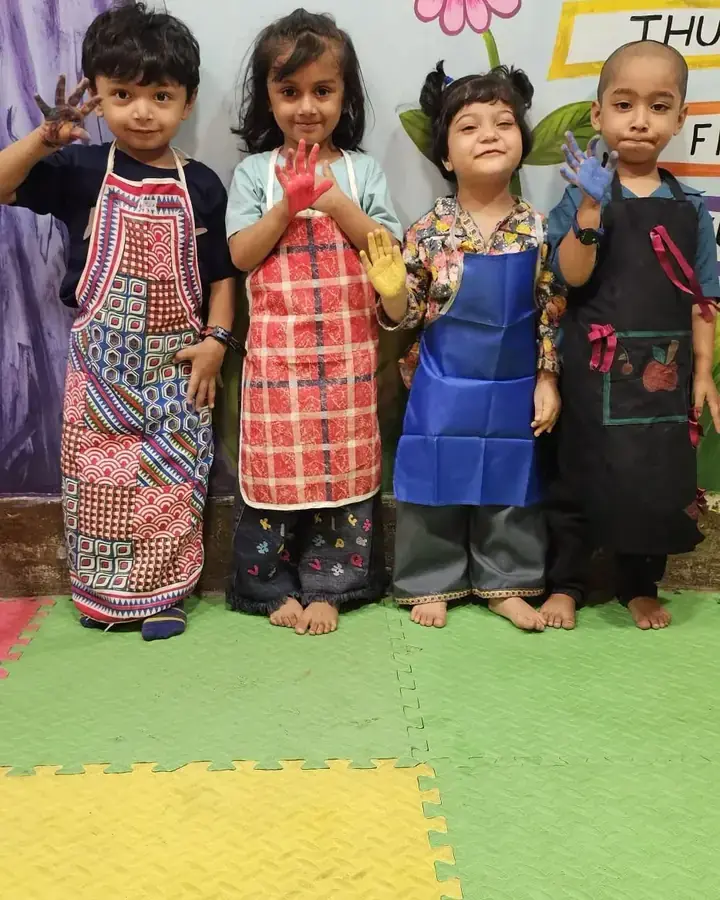
Adults tend to separate playing from studying. Young children don’t. When a four-year-old presses a painted palm onto paper, she isn’t only making art. She’s testing how hard to press, noticing cause and effect, naming colours out loud and controlling the small finger muscles that will one day hold a pencil steady.
Research on early childhood has said the same thing for decades. UNICEF describes learning through play as one of the most powerful ways young children learn, and Harvard’s Center on the Developing Child shows how back-and-forth interaction between an adult and a child builds the brain connections behind later reading, reasoning and self-control.
What we see in our classrooms matches this completely. Words taught through a game are remembered. Words drilled from a chart are forgotten by the next week.
Play is not a break from learning. In the early years, play is how learning happens.
A single well-planned activity often builds several skills at once. Across the pre-primary years, children develop:
| Skill Area | What It Looks Like in Class |
|---|---|
| Language | Naming objects, colours and body parts, answering questions, telling short stories |
| Fine motor skills | Painting, tracing, cutting, threading beads, rolling dough |
| Gross motor skills | Catching, throwing, balancing, dancing and action songs |
| Thinking skills | Sorting, matching, counting, noticing patterns, solving simple problems |
| Social skills | Sharing, taking turns, waiting, working in pairs and small groups |
| Islamic manners | Saying Bismillah, thanking friends, helping clean up, being kind to others |
When parents ask whether play really prepares children for school, this is the answer. Every one of these skills is something a child needs in Class 1.
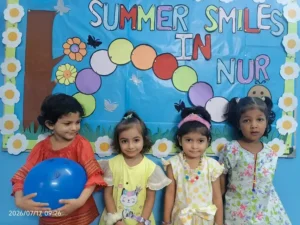
Our Summer Smiles theme gave the Nursery section a bright classroom display and a set of activities to go with it. The clear favourite was a balloon game used to teach the parts of the face.
Instead of pointing at a chart, the teacher handed out balloons. Children passed and caught them while she called out eyes, nose, ears, mouth and cheeks. Each child then had to find the same feature on themselves, and then on the friend standing next to them. Every word was repeated dozens of times, and not a single child felt like they were being tested.
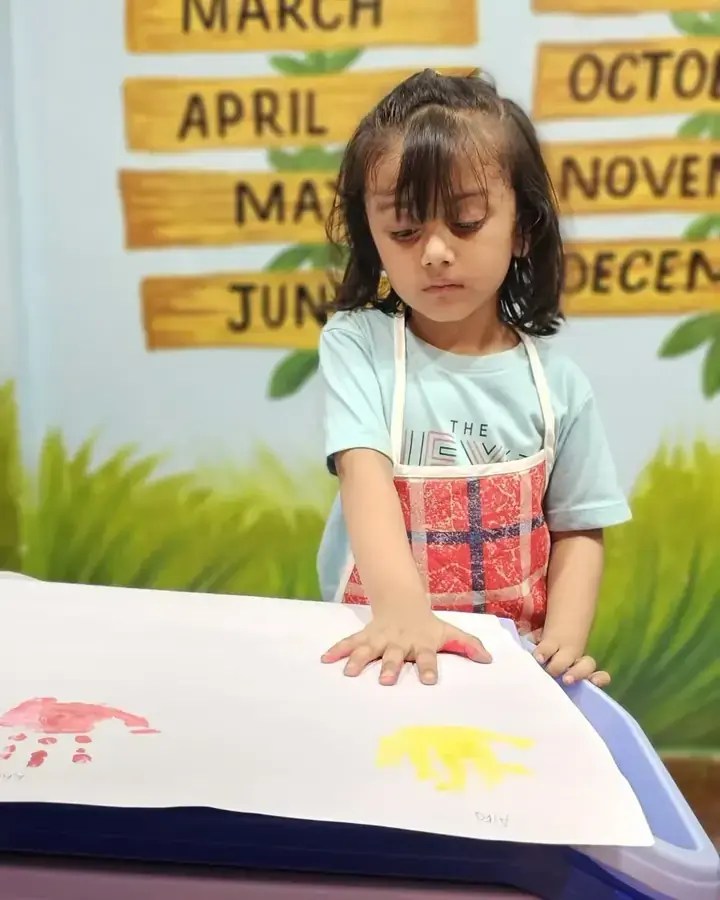
The second activity was hand printing. Aprons on, paint ready, and every child free to choose their own colour. Some pressed carefully and then studied the shape they’d left behind. Others went straight for two colours at once and used both hands. Both are exactly what we hope to see, because the goal here is exploration, not a neat finished product.
Hand printing looks simple, but it asks a lot of a small child. Spreading the fingers evenly, judging how firmly to press so the print is clear but not smudged, then lifting the hand straight up: each of these builds the fine motor control that later supports neat handwriting, scissor work and confident drawing.
There’s a social lesson running underneath the activity too. Children have to share a limited number of paint trays, wait while a classmate finishes and help clean up afterwards. With around 20 students per class and a student-to-teacher ratio of about 10 to 1, our teachers have time to guide each child through those moments individually, instead of simply announcing a rule to the whole room.
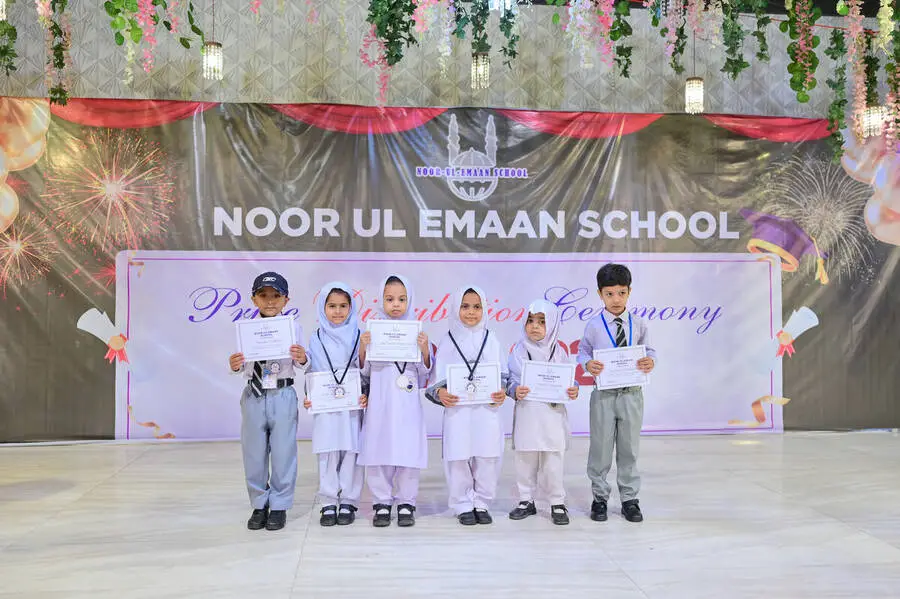
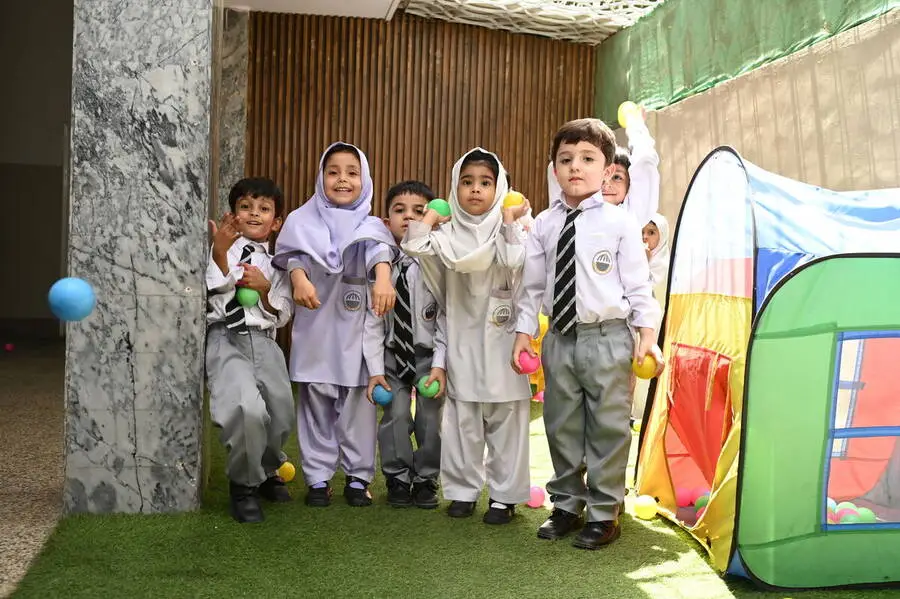
Parents often ask what a child actually gains from an art or movement session. Here’s what one well-planned activity develops.
Skill | What it looks like in class |
Fine motor control | Finger strength and grip that prepare a child for handwriting. |
Language growth | New words learned in context, so they’re remembered and used again. |
Sensory awareness | Understanding texture, colour mixing and wet versus dry. |
Confidence | Freedom to make choices with no wrong answer to be afraid of. |
Social skills | Sharing, waiting patiently and working calmly beside others. |
Focus | A longer attention span, built through work children genuinely enjoy. |
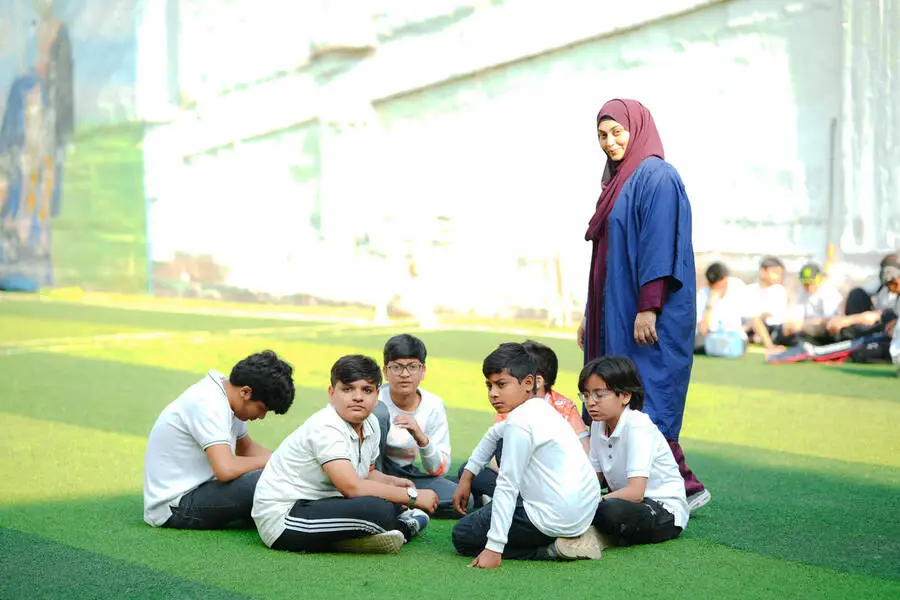
Activity based learning isn’t something we leave behind at the Nursery door. The same thinking carries on through our primary classes and secondary school, where we put understanding ahead of memorisation and keep encouraging students to ask why and how. Alongside academics, Quran and Hadith with Tafseer help students connect what they learn to strong values and daily practice.
The goal is a student who moves from Nursery all the way to Matric with their curiosity still alive, well prepared for Karachi Board exams and never taught to simply memorise and repeat. You can read more about this approach on our About page.
You don’t need special materials to keep this kind of learning going after school. Each of these takes just five to ten minutes.
Our pre-primary section is for children aged 3 to 5. Nursery starts at age 3, KG I at age 4 and KG II at age 5.
Yes. Children aged 3 to 5 learn best by touching, moving, talking and creating. Activity based learning builds the language, focus and fine motor skills they need before formal reading and writing begin.
Absolutely. Phonics, letter sounds, tracing and early writing are part of daily lessons. Activities simply help these skills stick, so by the end of KG II children are reading simple words and writing letters and numbers with confidence.
Each class has around 20 children, with a student-to-teacher ratio of about 10 to 1, so every child gets individual attention.
Fill in the form on our admission page or call 0301 205 1888 to book a campus visit and admission assessment. Our team will guide you through the remaining steps.